Only the work you actually need
An upgrade targets the specific gap, capacity, surge protection, or RCD arrangement, rather than replacing a board that is otherwise doing its job.
Consumer Unit Upgrade
Work on a board that already has RCBO protection but needs more from it, additional ways for new circuits, a surge protection device added, or specific RCD arrangements improved, scoped and priced individually because no two upgrades start from the same board.
Free, individual quote after a short look at your current board, no fixed package pricing on upgrades.
13 years
On the tools as an electrician
NAPIT 79130
Approved Domestic Installer
Free quotes
Priced individually, no fixed packages
£2m
Public liability insurance
The service
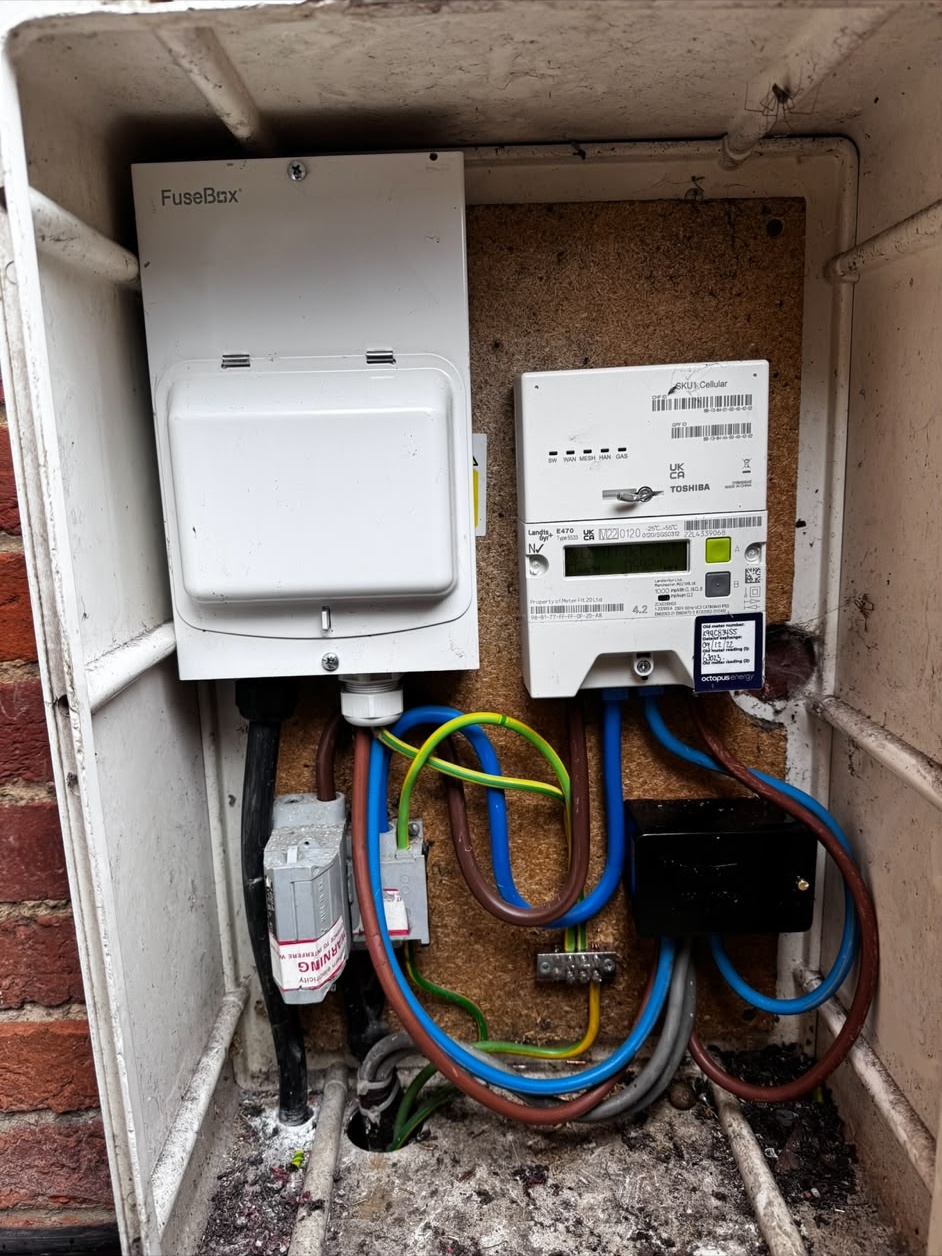
A consumer unit upgrade is work carried out on or around an existing board to give it more capacity or better protection than it currently has, as opposed to a straight swap of an old fuse board for a new one in the same position, which is a consumer unit replacement. Upgrades are for boards that are broadly fit for purpose but fall short in a specific way: not enough spare ways for a new circuit, no surge protection device, or an RCD arrangement that no longer matches how the property is actually used.
The most common upgrade is adding ways: fitting a way for a new circuit such as an EV charger supply already run by someone else, a garden office, a loft conversion, or a second consumer unit feeding an extension. This can mean fitting a larger board where the existing one has run out of space, or adding a small additional unit alongside it where relocating the main board is not practical.
Surge protection is another common request. A surge protection device fitted at the consumer unit protects the whole installation from transient voltage spikes, caused by lightning strikes on the network, switching events on the grid, or large appliances cycling on and off, before they reach sensitive electronics such as boilers, alarm systems and consumer devices. Since 2019, surge protection has been a requirement to consider on new and altered installations under BS 7671, and many older boards simply do not have one.
RCD and RCBO upgrades cover situations where individual circuit protection needs improving without a full board replacement: converting a shared RCD arrangement to individual RCBOs on the circuits that matter most, or adding a specific type of RCD (Type A rather than Type AC) where an appliance such as an EV charger or induction hob requires it. Because every board starts from a different point, upgrade work is priced individually after Adam has actually looked at what is there, not against a fixed price list.
Extensions, garden rooms, loft conversions and additional outbuildings often need a new way at the consumer unit. If there is spare capacity, this can sometimes be a smaller job than expected.
If your board predates 2019 or was never fitted with an SPD, adding one protects sensitive electronics and appliances against transient voltage spikes without replacing the whole unit.
Where one RCD still covers several circuits, or where a specific appliance now needs Type A protection, targeted RCD or RCBO work can resolve it without a full board swap.
What happens if it waits
A board that was correct when it was installed does not necessarily stay correct as a property's circuits and appliances change around it.
Discovering a board is full only when an extension or loft conversion is already underway turns a planned upgrade into a delay that holds up other trades.
Modern homes run more electronics than the boards installed a decade or two ago were ever designed around. Without an SPD, a switching surge on the network can damage a boiler control board or an alarm panel with no warning.
When several circuits share one RCD, a trip tells you something faulted somewhere on that group, not which circuit. Diagnosing the actual fault takes longer and the outage affects more of the house than necessary.
Certain appliances, including many EV chargers and induction hobs, produce DC leakage current that a standard Type AC RCD cannot reliably detect. The appliance needs a Type A device, or its own dedicated protection, to actually work as intended.
A garden supply added one year, an outbuilding the next, each connected to whatever spare way was available at the time, can leave a board loaded well past what its main protective device and cabling were sized for.
Adding capacity or an SPD as a standalone visit later is usually more straightforward than trying to force it in during another job. Planning it as its own piece of work tends to be the more controlled route.
How it works
Adam looks at the existing board, what is already connected, and exactly what the upgrade needs to achieve, added ways, surge protection, or RCD/RCBO changes.
Because starting points vary board to board, you get a written, individual quote covering the specific work needed rather than a fixed package price.
Existing load on the board and cable ratings are checked before any new circuit or device is added, to confirm the board and supply can genuinely take it.
New ways, an SPD, or revised RCD/RCBO arrangements are fitted, with existing circuits left connected and undisturbed unless the upgrade specifically requires touching them.
The altered installation is tested, an Electrical Installation Certificate or Minor Works Certificate is issued as appropriate, and notifiable work is registered through NAPIT.
What you get
An upgrade targets the specific gap, capacity, surge protection, or RCD arrangement, rather than replacing a board that is otherwise doing its job.
Type A RCD protection where an EV charger or induction hob needs it, rather than protection that predates the appliance being connected.
One SPD at the consumer unit protects everything downstream from transient voltage spikes, rather than relying on individual plug-in surge strips.
Added ways mean a new circuit for an extension, outbuilding or loft conversion does not automatically force a full consumer unit replacement.
Every quote reflects the actual board in front of Adam and the actual work required, given free before anything is agreed.
Upgrade work is tested, certified and registered through NAPIT as notifiable work, giving you documentation that matches what was actually done.
In detail
Upgrades sit between minor works and a full board replacement, and getting the scope right at the quote stage matters more here than on almost any other job.
Where a board has run out of spare ways, there are two realistic options: fit a larger consumer unit in place of the existing one, or add a second, smaller consumer unit alongside it fed from the same supply. Which makes sense depends on the main protective device rating, the space available, and how many additional circuits are actually needed.
A second unit alongside the existing board is often the quicker, less disruptive option where only one or two extra circuits are needed and the existing board is otherwise sound. Replacing with a larger single board makes more sense where several additions are planned or where the existing board has other issues worth addressing at the same time, at which point the conversation moves toward a consumer unit replacement rather than a pure upgrade.
A surge protection device is fitted at the consumer unit and works by diverting transient overvoltage away from the circuits it protects, clamping the voltage seen downstream to a safe level before it reaches appliances. It reacts in microseconds to events such as lightning-induced surges on the supply network or large inductive loads switching nearby.
SPDs are increasingly considered essential in properties with sensitive electronics, renewable energy equipment, or smart home systems, since a single surge event can damage several devices simultaneously. Retrofitting one to an existing board that has spare space is usually straightforward; where space is tight, it may need to be considered alongside adding ways or a board swap.
Where a board already uses individual RCBOs throughout, targeted upgrades are usually about type rather than arrangement, swapping a specific RCBO for a Type A version where a newly connected appliance requires it, for example. Where a board still uses a shared RCD arrangement, converting the most critical circuits to individual RCBOs can be done selectively without touching the rest of the board.
This kind of partial upgrade is judged on a case-by-case basis: sometimes it makes clear sense to isolate one circuit properly; other times, the condition of the rest of the board means a full replacement is the more honest recommendation, and that will be said plainly rather than left unmentioned.
During an upgrade assessment, it sometimes becomes clear that the existing board itself, not just its capacity or RCD arrangement, is the limiting factor, for example a plastic enclosure, degraded terminals, or a main switch rated too low for the load now being asked of it. When that happens, you are told directly rather than having an upgrade forced onto a board that is not a sound base to build on.
In that situation the honest recommendation moves to a consumer unit replacement, priced from £650 for a 6-way board, with any additional ways or SPD requirements folded into that new board rather than fitted twice. This is discussed and agreed before any work starts, never discovered partway through.
Not sure which one you need? Start on the homepage or send the details for a free quote.
Common questions
There is no fixed price list for upgrades because every board starts from a different point. Adam looks at the existing board and what you need, added ways, surge protection or RCD/RCBO work, and gives a free, written quote before anything is agreed.
A replacement is a straight swap of the whole board for a new one in the same position, priced from £650. An upgrade works on or alongside the existing board to add capacity or improve protection without necessarily replacing it.
Often, yes, provided there is spare capacity on the main protective device and either a spare way or room for a second small unit alongside the existing board. This is confirmed on a site visit before quoting.
It is worth considering for most homes, particularly where there are sensitive electronics, boiler control systems or smart devices. Since 2019, surge protection has been something that must be actively considered on new and altered installations under BS 7671.
Yes. Some appliances need Type A RCD protection rather than the older Type AC. This can often be addressed by fitting or swapping a specific RCBO without upgrading the whole board.
It depends entirely on scope, adding one way or an SPD to a board with spare space might take a few hours, while a more involved change could take longer. Timescale is confirmed as part of the quote.
Yes. Depending on the scope, either an Electrical Installation Certificate or a Minor Works Certificate is issued, and notifiable work is registered through NAPIT.
You will be told directly and given a separate quote for a full consumer unit replacement rather than having an upgrade forced onto an unsuitable board.
Yes. Jackson's Electrical Contractors is a NAPIT Approved Domestic Installer, registration 79130, holding NVQ Level 3 in Installing Electrotechnical Systems and Equipment and a passed AM2 assessment, with £2 million public liability and £250,000 professional indemnity cover.
Bank transfer is preferred, with a deposit required on larger upgrade work. Coverage includes Fleet, Farnborough, Aldershot, Guildford, Farnham, Camberley, Ascot, Yateley and Sandhurst.
Free, no-obligation quote
Describe what you need, an extra circuit, surge protection, or better RCD cover for a specific appliance, and Adam will look at your existing board and give you a free, individual price.